By Iris McLister // Feb 2018
In May of 2017, the Parrish Art Museum in New York exhibited a retrospective of modernist painter John Graham. In doing so, the museum didn’t just put on the largest show of Graham’s work in 30 years, it put on the only show of his work in 30 years. John Graham is not and perhaps will never be a household name, but the exhibition’s accompanying monograph, John Graham: Maverick Modernist, makes a forceful argument for why he’s important to the modern American art canon. At the helm of both the exhibition and the book was Parrish curator Alicia G. Longwell, who first wrote about Graham in 2007 for her dissertation. The book comprises around 70 paintings and works on paper, fleshed out with numerous photographs, insightful quotes, and in-depth essays; altogether, it’s an offering as cerebral as it is visual — a fitting tribute to the life and work of a man whose creative output refuses easy categorization.
In her 1967 book American Art Since 1900, critic and art historian Barbara Rose identified Graham as a painter “from whom [Arshile] Gorky’s generation learned to appreciate the finer lessons of Cubism,” citing a 1932 composition that “shows an understanding of the dynamics of synthetic Cubism which was rare, if not nonexistent, in America before that date.” In the preface to Maverick Modernist, Longwell avers that, “Much of the history of American art in the first half of the twentieth century pivots on Graham,” even though “his career has often been marginalized as a fascinating but eccentric chapter in art history.” The more we get to know Graham, the more puzzling it becomes that this should be the case; in addition to jumping from distinctive, opposing artistic styles, he also worked as an art dealer and advisor — clients included Vanity Fair editor Frank Crowninshield and Baltimore art doyennes Etta and Claribel Cone. He was an expert on primitive African art, which he bought and sold throughout his life. He was a passionate, multilingual writer whose 1937 article “Primitive Art and Picasso,” reproduced in full in the book, prompted Jackson Pollock to contact him. Graham also wrote a book, System and Dialectics of Art, which, though mostly ignored by critics, gained something of a cult following among artists.
Graham was born to an upper-class Polish family in Ukraine in 1886 as Ivan Gratianovitch Dombrowski. Growing up in Kiev, Graham studied and practiced law, served as a government official, fought in the Russian army during the First World War, and was imprisoned by the Bolsheviks. None of this hints at a career in painting, but when Graham left Russia for New York City in 1920, he enrolled at the storied Art Students League within a couple years of his arrival. There, the thirty-five-year-old novice artist studied under Ashcan School painter John Sloan alongside Adolph Gottlieb and Alexander Calder. It was during this time that Graham met two artists whom Longwell calls Graham’s “more celebrated confrères”: Gorky and Stuart Davis, with whom Graham forged decades-long friendships.
Graham first encountered the work of Picasso in Moscow in the early 1900s, during a visit to the home of collector Sergei Shchukin. In a 1931 letter to his longtime patron, the artist and critic Duncan Phillips, Graham writes, “All painting after Picasso is after and cannot be before, such is the law of time. We all use the discoveries of the past as we all use brushes and canvas.” That Picasso left a profound creative impact on Graham is evidenced in many of his early works, including a still life from 1926, which is crammed full of objects, including assorted fruits and a glass bottle. At the center of the composition is a striped blue-and-white jug, partially reflected in a dirty mirror below. Perspective is an afterthought, with background curtains and napkins receding into gray-brown Picassoid shapes and colors.
In 1928’s Interior, Graham used blunt, deliberate perspective and de-Chiricoesque chiaroscuro to create an eerie scene of opened doors and windows. Its beguiling palette of dusky pinks and olive serve as a sort of stage-set, with opened doors and windows flanking a hallway populated by ghostlike figures. The superb Still Life With New York Times (1927) is dominated by a dark table, haphazardly topped with a knife, a bit of bread, and a blue fish that somewhat humorously appears to have been flopped onto the a platter alongside a bruised banana. The composition’s rolled, titular newspaper is partially obscured by a large milk jug. Painted half black and half white, it bypasses subtle shadowing to resemble an abstracted, striped shape as much as it does a vessel.
By the 1930s, Graham wasn’t just teetering on the brink of abstraction. Red Square (1934), while not especially compelling, focuses exclusively on shape and color — in this case, an irregular red-orange square set against fields of white and black. In the charming Embrace (1932), the left side of the composition contains a whitish half-circle whose lower portion tapers into a sort of foot. On the right, the top half of a yellow rectangular shape seems to lean towards the white one, its own blocky footlike appendage ending in abrupt, evenly spaced black lines. The upper portions of both shapes have black circles where eyes might be, and though the painting initially appears abstracted, it’s also representational — albeit cartoonishly so.
Graham’s frequent travels to Paris afforded him what essayist Sophie Egly calls an “intense artistic stimulation ... promoted by the prevalence of supportive art dealers, collectors, poets, critics, and intellectuals, who were as multinational as the artists they championed.” By the early 1940s, Graham had all but rejected Cubist and abstract styles to focus on figuration. He would even go so far as to disavow his former hero, Picasso, writing that the artist’s “fame is a great international, money-making intrigue. His art is a hoax.”
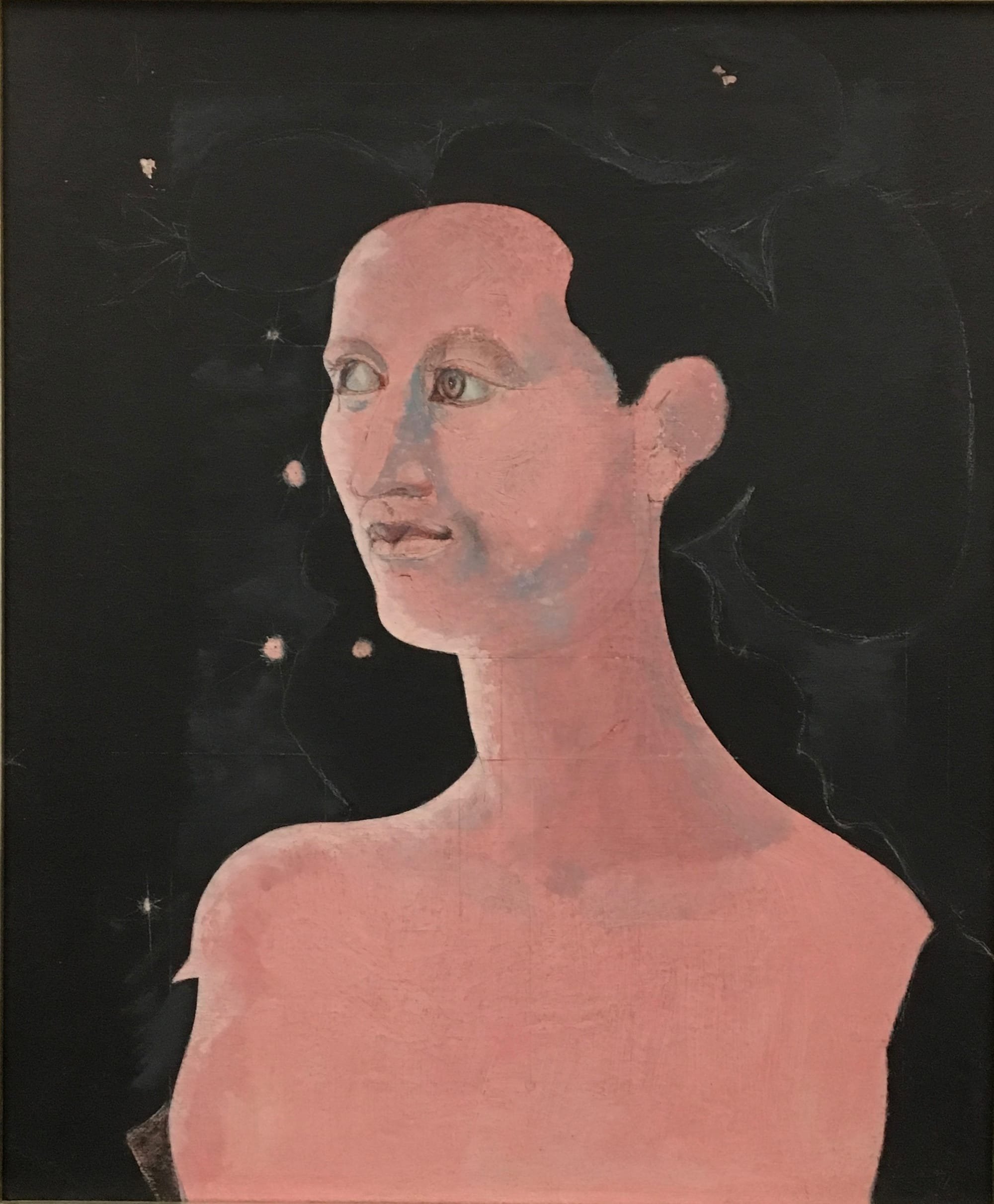
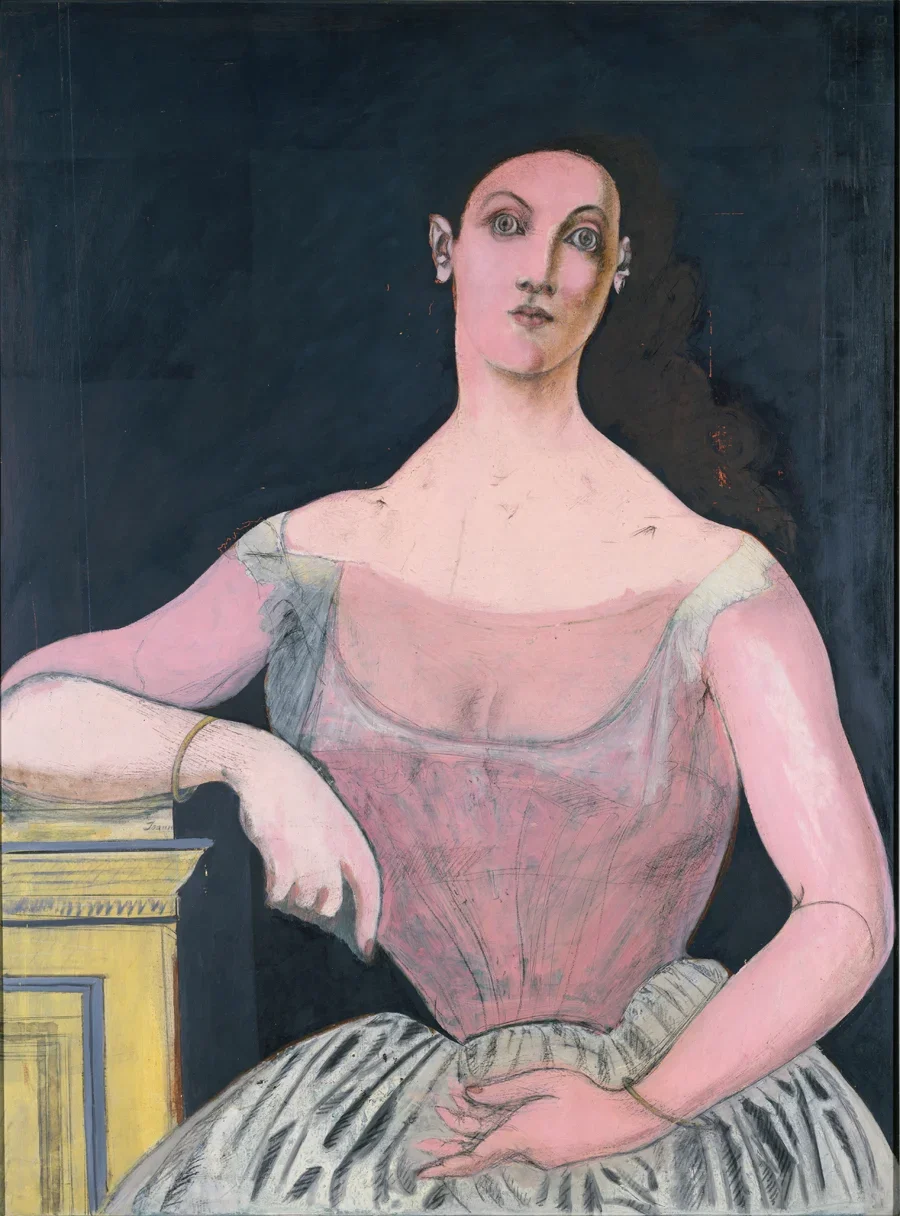
The portraits Graham made from the 1940s onward are nervy, neurotic, and often a little disconcerting; in many instances, their female subjects’ eyes are crossed. Graham once explained, “I ... paint women, dangerous women, mystical women. Cross-eyed women? Yes, it’s a charming thing for women to be a little cross-eyed; it indicates modesty, a certain confusion, a little perplexity.” Contributor Karen Wilkin writes, “Graham explained the crossed eyes to an acquaintance as documenting his observation of women at peak sexual ecstasy.” Marya (Donna Ferita: Pensive Lady), from 1944, is a handsome portrait of a woman whose dark, billowy dress recalls those of Ingres’ romantic portraits, and whose blunt, flat planes of color and disregard for proportion are evocative of Modigliani. The subject’s face is gentle and open, her eyes slightly crossed, but not distractingly so. Peculiarly, a blood-red gash spans her right wrist. Little cuts or gouges appear in other works too; in Donna Losca, a portrait from 1959, a classically styled drawing of a woman with darkly crossed eyes is overlaid with decidedly phallic doodles, and a tiny sword punctures the figure’s mouth. Little drops of blood dribble down her chin. Though some of his portraits have an undeniable if left-of-center sensuality, Graham’s brand of eroticism is murky, more perplexing than sexy. Elsewhere in his work, Graham crafts his subject material with the meticulousness of a superb draftsman, with a practically scientific approach to drawing that borders on the obsessive. His Stallion from the early ’50s, for example, with the subject’s rippling musculature and stern countenance, shines for its painstakingly arranged composition, with each figure in the drawing purposefully placed, though the design behind the configuration is also murky.
Ultimately, there’s no such thing as a typical John Graham painting. It’s hard to draw conclusions about a person who seems to have been so determinedly complicated, even with the assistance of a book as exacting as this. Graham was indeed a “maverick modernist,” a consummate and committed artist whose wide range of styles make his complex legacy all the more alluring.
“John Graham: Maverick Modernist” by Alicia G. Longwell, with essays by William C. Agee, Sophie Egly, and Karen Wilkin, is published by DelMonico Books/Prestel.